
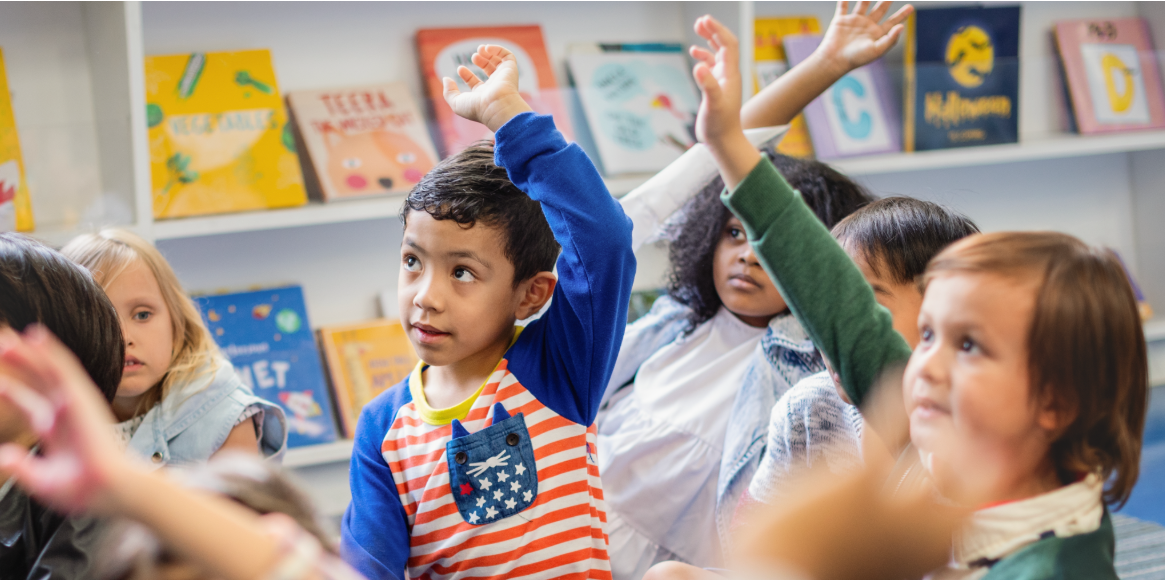
The Early Years Foundation Stage Statutory Framework makes clear that Personal, Social and Emotional Development (PSED) is crucial for all children’s development, and that the groundwork for a child’s overall wellbeing, approach to learning and ability to form positive relationships is laid during the Early Years. The Early Years are both a time of play and nurture, and an incredible opportunity for learning and development; in fact, much of children’s learning comes from play, nurture and experience itself, amongst the ‘small’ day-to-day experiences, routines and peer interactions.
PSED Early Leaning Goals
At Life Lessons, we recognise that the Early Years are a distinct developmental phase, where the typical pedagogy of even a Key Stage 1 classroom is not always appropriate. As a result, we are excited to launch our Early Years resources, designed specifically for Reception classrooms, to support development towards the PSED Early Learning Goals (ELGs):
- Self-Regulation
- Managing Self
- Building Relationships
These resources draw on key pedagogical approaches including:
- Narrative
- Teacher guided activities
- Independent exploration activities – including enhanced provision
- Explicit teaching slides
The slide decks can be used flexibly according to the needs of the children, and to support this, each one contains specific teacher guidance and each ELG has a set of adaptable templates.
Additionally, we have created an EYFS PSED Staff Support Guide which can be used by all Early Years staff. This guide encourages the creation of observable learning opportunities for each PSED ELG across provision, and indicates what children displaying each PSED skill could look like. Alongside this are suggestions of what staff can say to support the development of these crucial skills.
Early Years pedagogy
We have used an Early Years specific pedagogy in the development of these resources, centering play, active learning and explicit teaching. The slide decks can be delivered in one go, such as if a class needs to work on one particular ELG statement, or can be delivered in small chunks at different times. The narratives are also designed to bring the ‘internal world’ – such as emotions – into the ‘external world’ for children to learn from and understand: they reflect typical challenges for this year group, and can be used to explore and develop skills such as turn-taking and managing impulses.
The EYFS framework identifies three characteristics of effective teaching and learning – ‘playing and exploring’, ‘active learning’ and ‘creating and thinking critically’. We have embedded these characteristics across all our resources, using icons to show where each characteristic is present in the slide deck.
Early Years and Primary
Our Early Years resources share some of the key features of our Primary materials, allowing for familiarity and consistency as they progress. Both our Early Years and our Primary materials have the same:
- Core phases: ‘Explore’, ‘Understand’ and ‘Activate’, with discussion throughout
- Character illustrations
- Accessibility considerations e.g. dual coding, WCAG-aligned slide decks, animation to reduce cognitive load
- Prioritisation of photos where appropriate, so that children can easily make connections between what they’re learning and the world around them
These new resources offer primary and infant schools a way to bring Life Lessons into the Early Years classroom, where teachers have the resources to feel confident supporting children to meet the PSED ELGs – resources that are structured enough to reduce teacher workload and increase staff confidence, but with enough flexibility and adaptability to meet the varying needs of the children in their class.
To find out more about our Early Years and Primary resources, visit www.lifelessons.co.uk or contact us at hello@lifelessons.co.uk.