
The Department for Education recently published the National Behaviour Survey Report which details findings on behaviour, school culture, how behaviour is managed in schools and the impact of behaviour challenges on schools and learning. At Life Lessons, we take an evidence-informed approach, keeping up to date with the latest research about what is happening in classrooms and responding to this through our range of resources and staff CPD.
Feeling safe at school
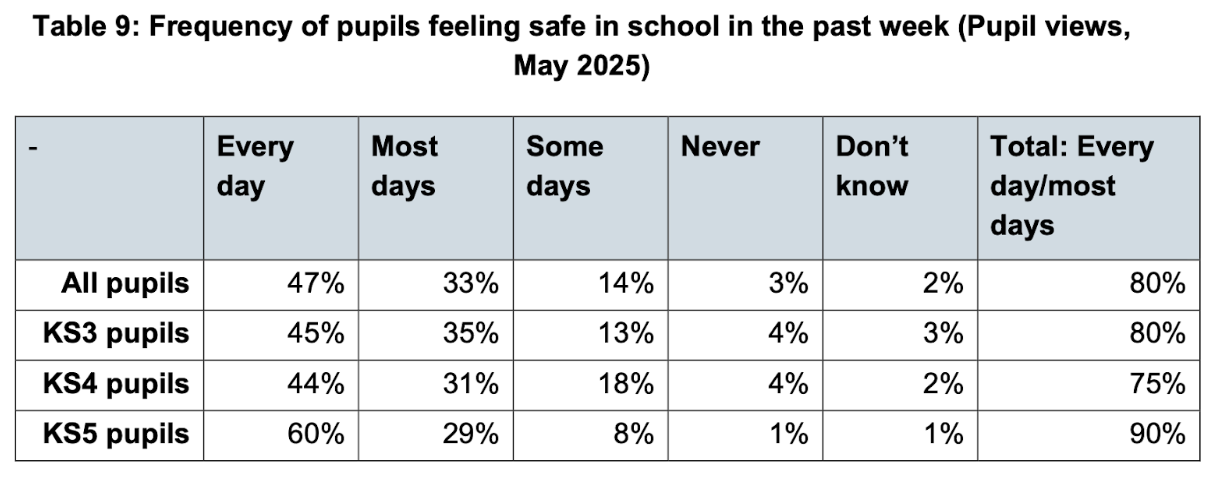
(National Behaviour Survey Report, 2025, p44)
The report found that less than half of secondary school pupils feel safe everyday at school. We know that feeling safe is a necessity for not only learning, but for children’s overall wellbeing and ability to thrive.
To support schools to create a safe environment for all pupils, Life Lessons takes a whole-school positive and relational approach to wellbeing. We offer opportunities to build a safe and supportive community through:
- opportunities and scaffolding for young people to develop a range of relationships
- discussion-led learning supported by ground rules
- inclusive and accessible materials that represent a range of communities and identities
- reflection focused and restorative behaviour intervention materials
- staff training that supports educators to foster positive relationships with young people
According to the report, the majority of teachers and school leaders surveyed reported that pupil behaviour had negatively impacted their health and wellbeing in the past week. Life Lessons recognises that all behaviour is communication, taking a restorative approach to managing challenging behaviour, whilst also acknowledging the impact that this behaviour has on school staff members, by providing staff CPD and webinars that support the professional development of all teachers, including non-partner teachers.
Emotional regulation and bullying
Our curriculum explicitly teaches emotional regulation strategies to encourage young people to display healthy behaviours. However, going beyond universal curriculum, we also support schools to address behaviour challenges through our educational, restorative interventions that tackle issues that commonly occur in schools, such as:
- sexism and misogyny
- anti-social behaviour
- hate speech
- sexualised language.
These behaviour interventions build on the knowledge and skills developed in our curriculum resources, offering the opportunity for young people to explore the impacts of their behaviour and how this affects their peers, wider school community and relates to society more broadly.
With an accompanying parent information sheet for each intervention and a reflective conversation framework for teachers, schools are supported to tackle the root issues causing behaviour challenges in a way that is supportive of staff wellbeing and workload.
Additionally, the report outlines that pupils in Years 7-13 who report in-person bullying believe that this is largely due to their appearance. Other perceived reasons included protected characters such as disability, sexuality and ethnicity. Both our primary and secondary curriculums challenge this by celebrating difference and inclusion, offering opportunities to develop empathy through hearing the ideas and experiences of different pupils through both discussion and our peer-led videos.
Mental wellbeing strategies
Our approach to behaviour reflects our belief that in many cases, when young people are happy, feel connected to those around them and are supported, they are able to make healthier behaviour choices. We know that to achieve this, a few minutes a day of deep breathing is not enough: the Key Findings Report 2025 published by the Evidence Based Practice Unit suggests that the effectiveness of structured mindfulness varies across schools and pupils, with some pupils finding this ‘boring, stressful or physically uncomfortable’ (p.10). In line with this report’s findings, Life Lessons teaches a range of mental wellbeing strategies- including creative and movement based activities- so that every young person feels empowered to use techniques that are helpful for them.
We also recognise that there are gender differences in seeking mental health support. According to the Key Findings Report, girls need ‘a space to be heard, seen and accepted’ (p.10) and we believe that every child benefits from a supportive space where their feelings are taken seriously by the adults around them. As a result, we take a relational approach, emphasising the importance of not only a positive teacher-student relationship, but also supportive peer relationships, where talking about feelings and wellbeing is celebrated regardless of gender. Additionally, young people are equipped with the skills to check in and recognise when their peers may need support. In particular, we provide opportunities to discuss healthy masculinity, gender stereotypes and the importance of sharing emotions, and provide relevant mental health information to reduce barriers to accessing mental health support.
Some of the key themes raised in this research are that of safety and belonging, emotional wellbeing and the importance of supportive peer relationships. These themes cannot be addressed in isolated curriculum lessons- they should form part of a whole-school approach where they are embedded in positive student-staff relationships, effective behaviour interventions and regular opportunities to practise the skills gained in PSHE and beyond. At Life Lessons, our evidence-informed whole-school approach and range of resources support school communities to create an environment where young people feel safe, believe that they belong and are supported in their understanding of emotional regulation and wellbeing. If you would like to learn more about our resources, contact us at hello@lifelessons.co.uk or visit lifelessons.co.uk
This blog post is a response to research findings about behaviour and young people’s wellbeing.